
Paver Patio vs. Concrete in Wisconsin Winters
Both can make a good patio. The difference shows up after a few Wisconsin winters, when the ground has frozen and thawed dozens of times underneath.
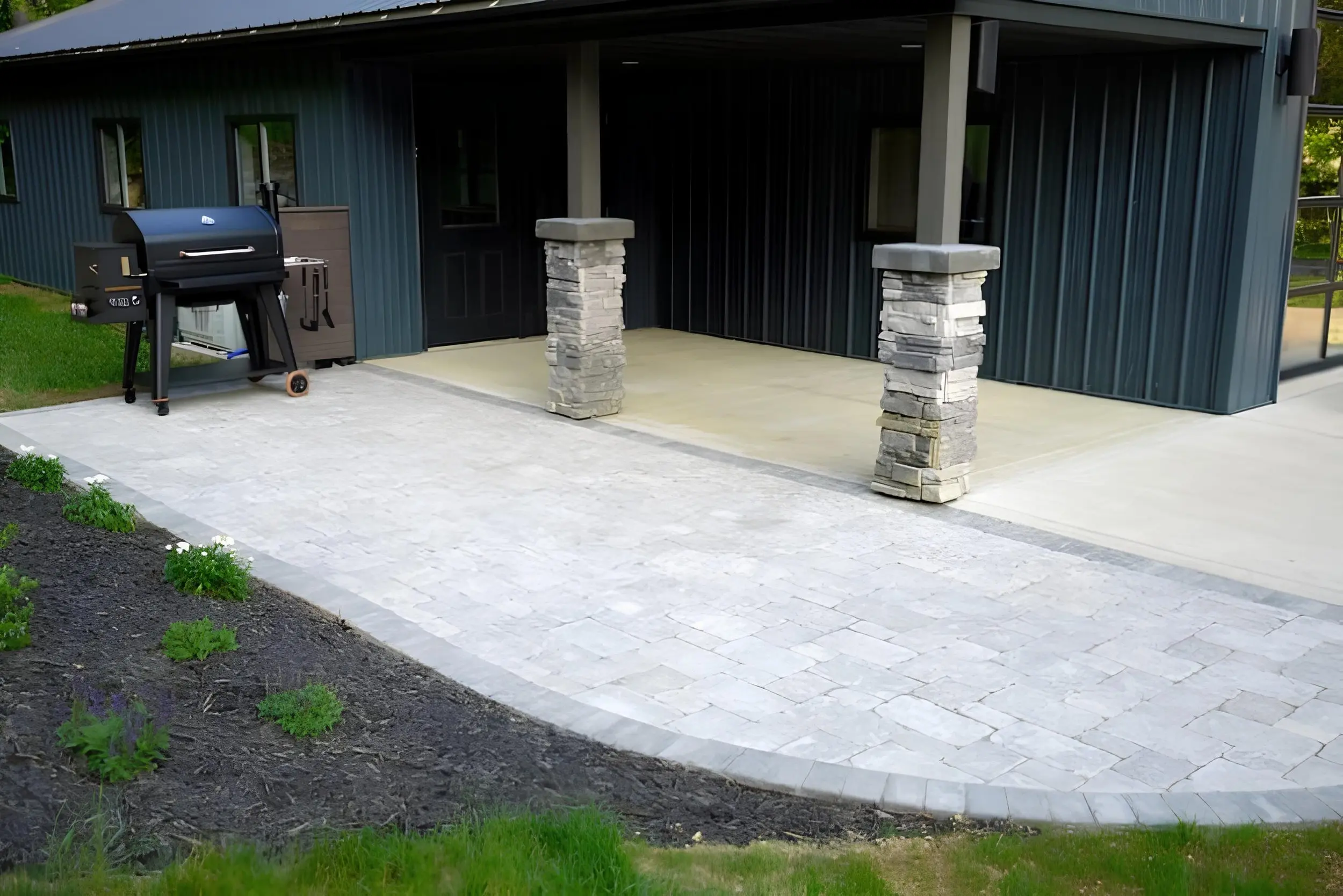
Around Madison the ground freezes deep, and much of Dane County sits on clay that holds water. When wet soil freezes it expands and lifts whatever is on top of it. How a patio deals with that movement is the real difference between the two.
How concrete handles frost
Poured concrete is one solid slab. It is strong, but it can't flex, so when the ground under it moves, the slab cracks. Control joints help steer those cracks, but they don't stop them. A crack in a slab is there for good. Patches show, and tinted or stamped concrete is hard to match later.
Concrete is also hard on de-icing salt. Salt and freeze-thaw cycles can flake the top layer off, especially on newer slabs.
How pavers handle frost
A paver patio is thousands of separate units on a compacted stone base. The joints let the surface move a little and settle back rather than crack. If one area ever does settle, or a paver gets stained, that section can be lifted, re-leveled and put back with the same pavers. Try that with a slab.
Pavers also give you more choices: colors, tumbled edges, borders, curves and fire pit circles.
Where pavers can go wrong
Pavers are only as good as what is under them. Most of the sunken, wavy patios you see around town were built on a thin base. Here is what we build every paver job on, and what we would ask any contractor about:
- At least 6 inches of compacted 3/4-inch crushed stone, even for a walkway, and more on clay or under a driveway. Some crews use 4.
- Compaction in thin lifts, not one thick layer rolled once at the end.
- One inch of bedding sand and no more. A thick sand bed ruts.
- Edge restraint on every open side, or the patio slowly spreads.
- Polymeric joint sand, swept in and set, to lock the pavers and slow weeds.
Upkeep
Concrete needs resealing every so often if it has been stamped or colored. Pavers may need joint sand topped up over the years and an occasional wash. Both do best when you use a salt that is safe for the surface, and less of it. Sand gives grip when it is too cold for salt to work.
Cost
Pavers usually cost more up front than plain poured concrete, because of the base work and the hand labor. Stamped concrete can get close to pavers. Over the life of a patio, it often comes down to which one you would rather fix: a few pavers, or a whole slab.
Which should you pick?
If the budget is tight and you want a plain, flat surface, concrete does the job. If you want a patio that can move with a Wisconsin winter, can be repaired without showing it and looks like more than a slab, go with pavers on a proper base.
See our patios and pathways or get a free estimate.